Locations
A Location is a group of staff with its own managers. It can be a place, like a restaurant, or a team, like Housekeeping or Customer Support. This guide explains what Locations do in Microkeeper and how to set each one up.
| Required plan | All plans |
|---|---|
| Required access | Settings |
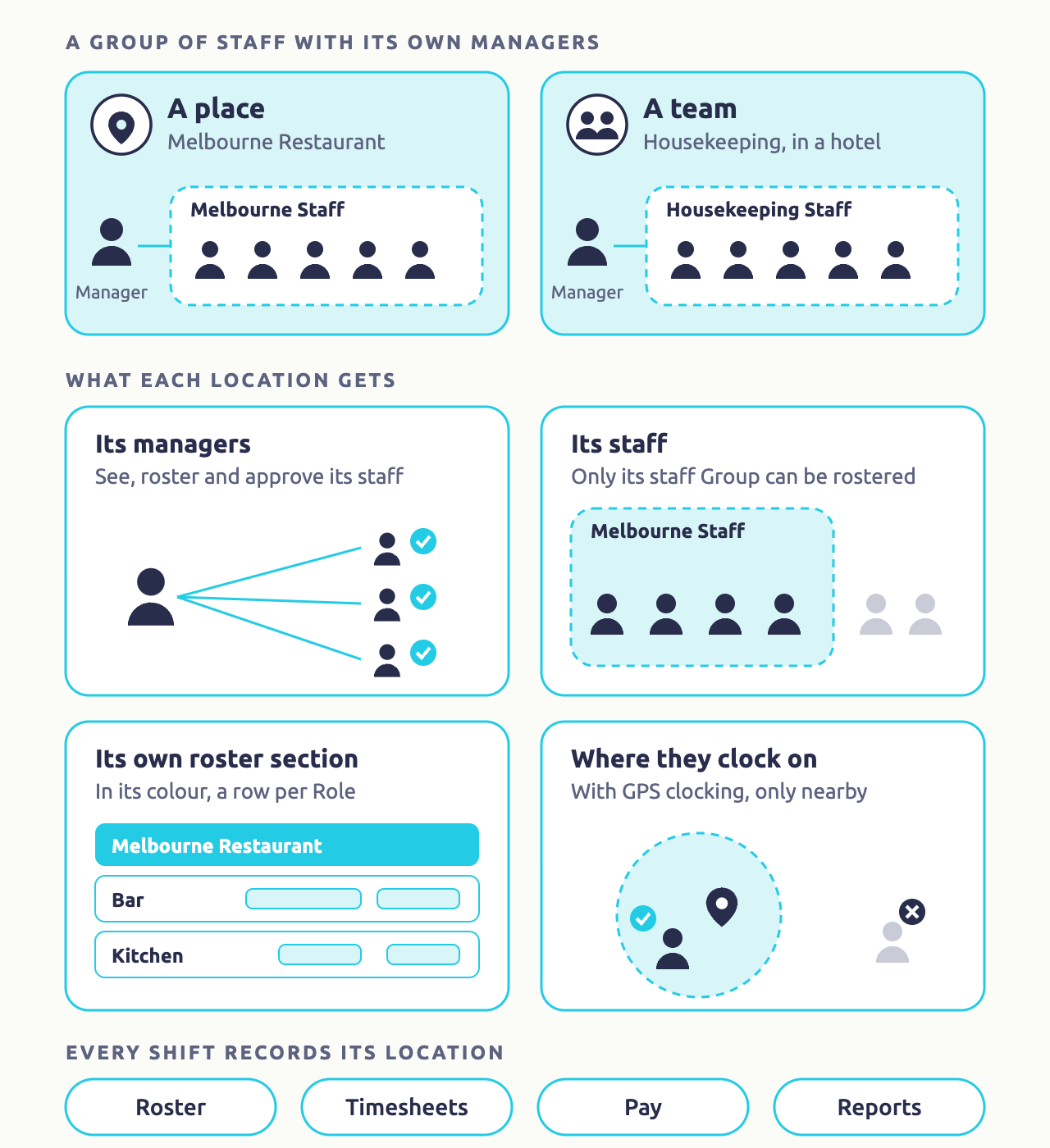
What a Location is
A Location is a group of staff with its own managers and its own section of the roster. Its managers roster those staff and approve their shifts, and every shift they work records the Location.
A Location can be a place or a team:
- A place. A business with two restaurants has two Locations, "Melbourne Restaurant" and "Sydney Restaurant", each run by its own manager.
- A team. A hotel run by departments has a Location for each department, such as "Front Office", "Housekeeping" and "Food and Beverage", each run by its department head. An office might have "Sales" and "Customer Support".
Make a Location for each group of staff that someone manages. If one person manages everyone, one Location is all you need.
Location, Role or Job: which to use
Managers are chosen for each Location, so a team with its own manager is a Location. Inside it, Roles sort the work on the roster, and Jobs record what the time is for:
| Restaurant | Hotel run by departments | |
|---|---|---|
| Locations | Melbourne Restaurant, Sydney Restaurant | Front Office, Housekeeping, Food and Beverage |
| Managers | Each restaurant manager | Each department head |
| Roles | Bar, Kitchen, Front of House |
|
| Jobs | Private Functions | Weddings, Conferences |
What uses a Location
| Area | How it uses the Location |
|---|---|
| Roster Calendar | Each Location has its own section, in the Location's colour. Inside it is a row for each Role linked to the Location. |
| Who can be rostered | The Location's staff Group sets which staff can be rostered and managed there. |
| Managers | The managers you choose for a Location see, roster and approve its staff. |
| Clocking | A Geo-Fence limits where staff can clock on, and a default Job is added when staff clock on at the Location. |
| Timesheets and reports | Every shift records its Location, so you can see hours and wages for each Location. |
Your first Location, the HQ Location
When you first log in, Microkeeper creates a Location named after your business, ending in "HQ". Rename it to your main place or team rather than adding a new Location. Locations can't be deleted, only archived, so an unused HQ Location stays in your account.
Navigate to Menu > Settings > General > Locations.
- Click the pencil button next to your HQ Location. The Update Location form opens at the General tab.
- Change the Title to the name your staff know it by, for example "Melbourne Restaurant".
- Click Update.
If one person manages all your staff, this is the only Location you need.
Add a Location
Navigate to Menu > Settings > General > Locations.
- Click Add Location.
- Enter the Title, for example "Sydney Restaurant".
- Click Add.
The Add Location form only asks for the Title. A new Location starts with All Staff as its Group and a budget of 100 hours and $10,000. To change its settings, click the pencil button next to it, change the tabs described below and click Update.
Roster SMS messages show only the first five characters of a Location's title, so make the start of each title different.
Location General tab: address, budget and colour
The General tab opens first when you edit a Location.
- Address: click the pencil button and enter the Location's street address. Until you do, it shows "No address set".
- Budget (HR / $): the hours and cost budget for the Location, which guides whoever writes the roster. The Budget (Hrs/$) column on the Locations list shows it.
- Colour Picker: the colour that shows this Location on the roster. Click a colour to choose it.
Location Access tab: staff Group and Managers
Who works at a Location and who manages it are set on the Access tab, not the General tab that opens first.
- Click the pencil button next to the Location.
- Click the Access tab.
- In Group, choose the Group of staff who can be rostered and managed at this Location, for example "Melbourne Staff". All Staff lets everyone work there.
- In Managers, click Select Manager and tick each manager responsible for the staff at this Location.
- Click Update.
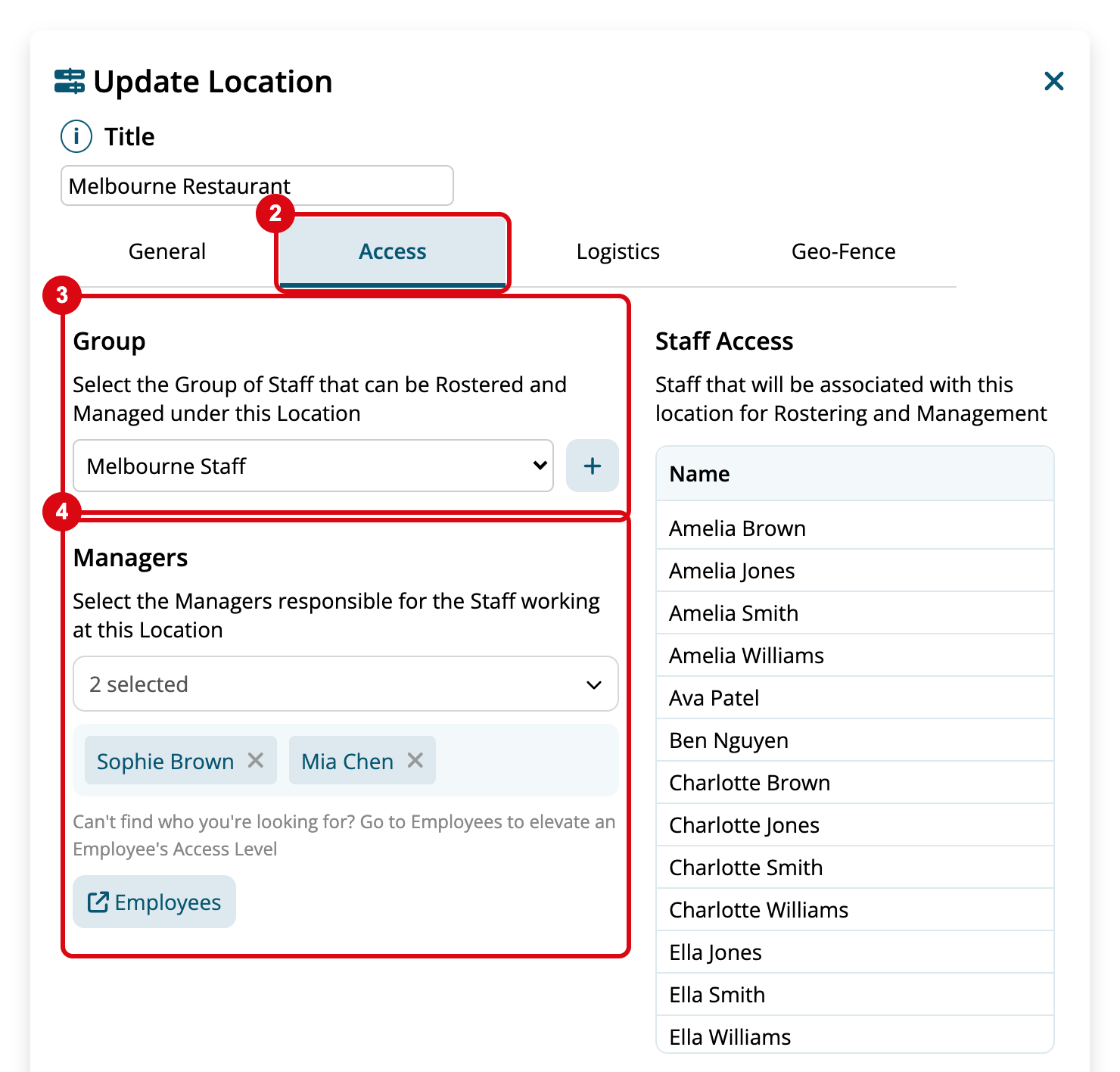
Staff Access, on the right of the tab, lists the active staff in the chosen Group. You can't edit it here. To change who is in it, change the Group or the Group's members. See Groups.
Only active staff with manager access can be chosen in Managers. Give someone access in the Access Control section of their employee profile, for example Roster, Timesheet or Leave access, then come back and choose them. The Employees button on the tab opens your staff list in a new tab. See Managers and Access for what each level lets a manager do.
Location Logistics tab: Roles, default Job, Client and Skills
The Logistics tab sets what work is done at a Location. The most important setting is Roles: the Roster Calendar only shows the Roles linked to each Location.
- Click the pencil button next to the Location.
- Click the Logistics tab.
- In Roles, choose each Role worked at this Location from Select Role. Each one is added below the list.
- Click Update.
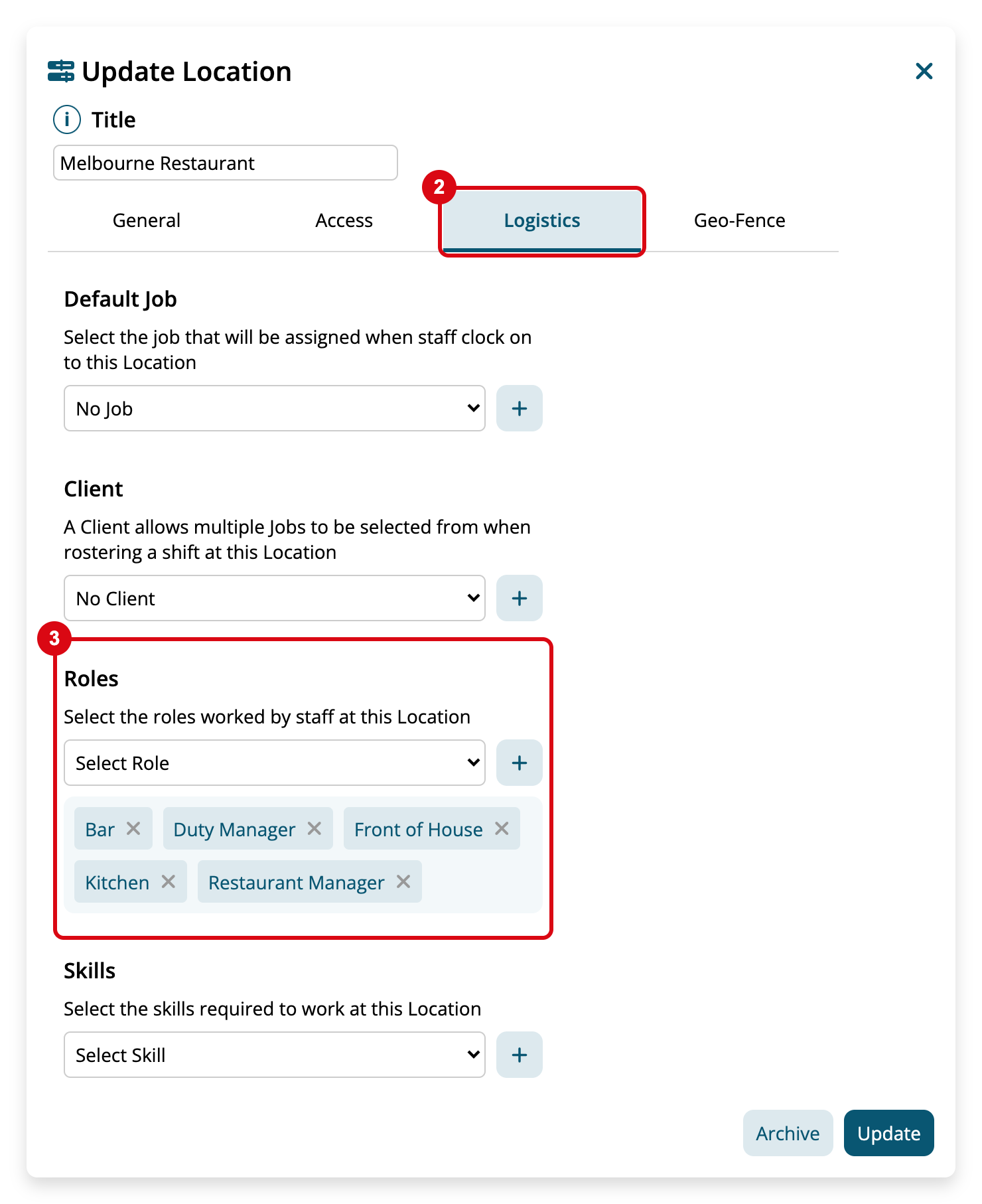
The other settings on this tab are optional:
- Default Job: the Job added when staff clock on at this Location. Leave it as No Job if you don't track hours by Job.
- Client: choose a client to let shifts at this Location pick from that client's Jobs, or All Jobs to allow any Job. The default is No Client.
- Skills: the skills staff need to work at this Location, chosen from Select Skill.
The plus button next to Group, Default Job, Client, Roles or Skills opens a form to add a new one without leaving the Location. See Roles and Jobs.
Location Geo-Fence tab: where staff can clock on
The Geo-Fence tab sets the GPS position of a Location, so staff can only clock on when they're near it.
- Click the pencil button next to the Location, then the Geo-Fence tab.
- In Search, type the Location's address and click the search button. This fills in Latitude and Longitude. You can also type them yourself.
- On the map, drag the red pin to the exact spot if it needs adjusting.
- Click Update.
The Geo-Fence only applies to staff whose Employee Clocking is set to GPS location restricted on their employee profile. The size of the area is the GPS Radius in Menu > Settings > General > Global > Timesheet Settings, between 40 and 1,000 metres. To choose how staff clock on, see Clocking Options.
Locations as cost centres
Location is one of Microkeeper's three cost centres, with Role and Job. Every shift records a Location, a Role and a Job, so you can see hours and wages for each. See Cost Centres for how a shift gets its cost centres and where they show up.
Archive or reactivate a Location
When you stop working at a Location, archive it. Locations can't be deleted.
- Click the pencil button next to the Location.
- Click Archive.
- Click OK to confirm.
Warning
Rosters for an archived Location can no longer be accessed. Archive a Location only when no one works there any more.
Archived Locations move to the Archived tab of the Locations list. To bring one back, click the Archived tab, then Reactivate next to the Location.