Shift Rules
Shift Rules decide how the hours in a timesheet are paid. Each rule pays the hours of a shift that match it, such as the hours after 8 on any shift, or every hour on a Sunday, at a rate or multiplier of the employee's base rate. Shift Rules pay casual loadings, weekend and late night penalties, overtime, worked public holidays, leave loading, higher duties and short rest between shifts.
| Required plan | All plans |
|---|---|
| Required access | Settings and Payroll - Full Access |
Navigate to Menu > Settings > Payroll Rules > Shift Rules.
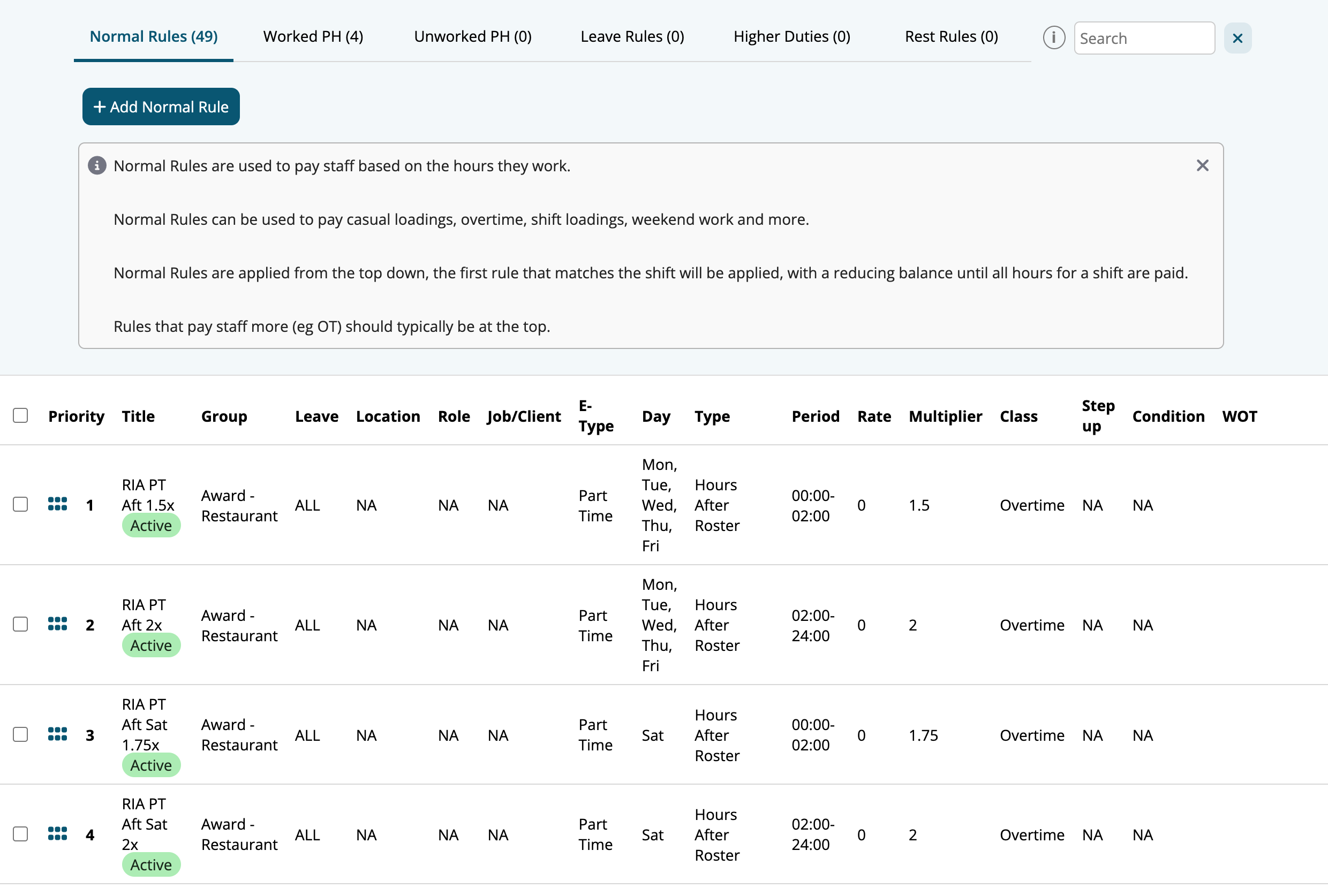
How Shift Rules pay a shift
Shift Rules are checked from the top of the list down. The first rule that matches an hour pays it, and the rules below only pay the hours that are left. Hours no rule pays are paid as Basic, at the base rate.
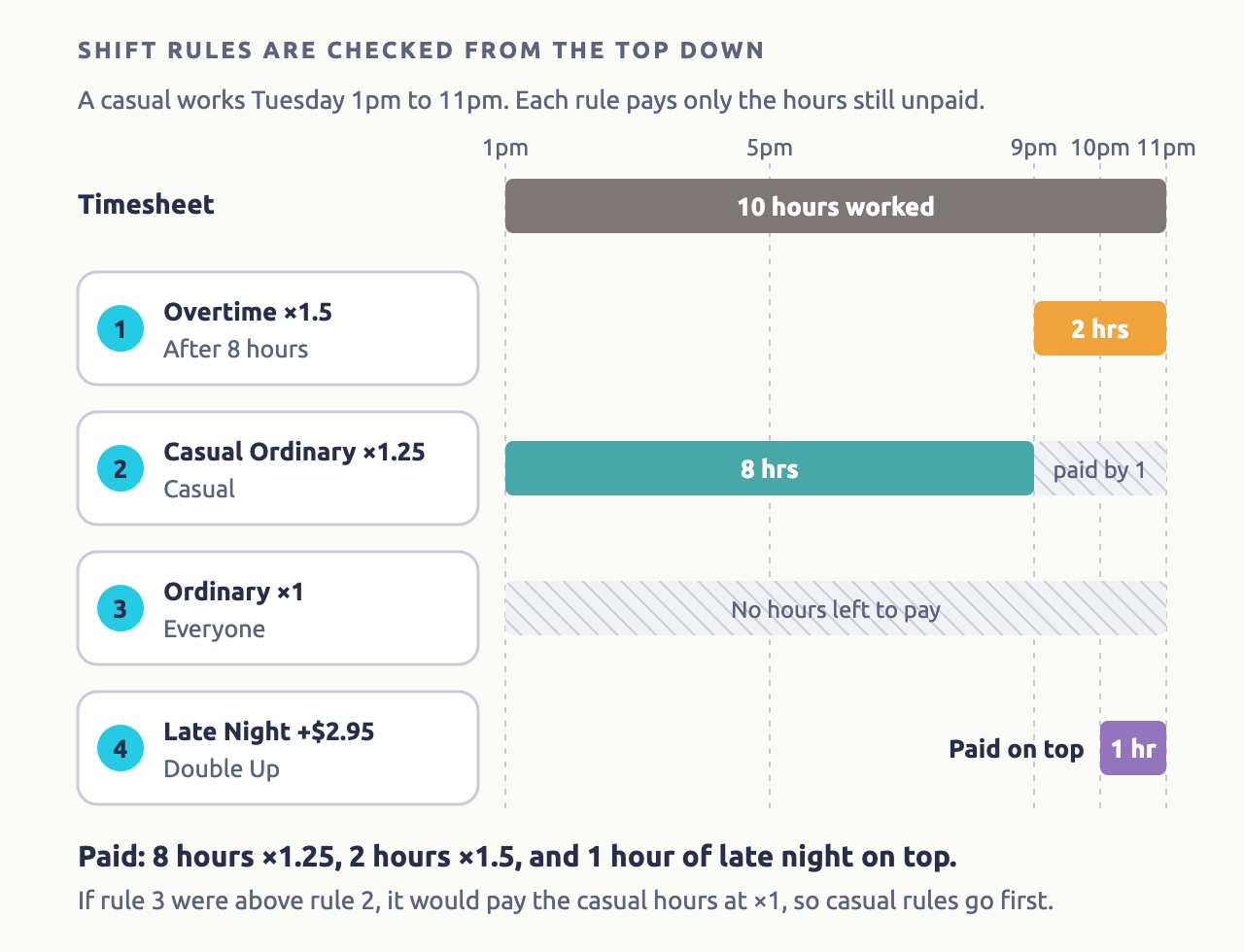
So the order matters:
- Put overtime and other rules that pay more at the top, so they take their hours first.
- Put rules for some staff, such as casuals or one Group, above the rules for everyone.
- Set penalties that are paid on top of the hours, such as late night work, to Double Up. A Double Up rule doesn't take the hours from the rules below it.
The tabs are checked in this order: Higher Duties, Rest Rules, Worked PH, Unworked PH, Leave Rules, then Normal Rules. Within each tab, the order is the rules' Priority.
Which Shift Rules tab to use
| Tab | Pays | Example |
|---|---|---|
| Normal Rules | Hours worked | Casual loading, Saturday rates, overtime after 7.6 hours |
| Worked PH | Hours worked on a public holiday | Double time and a half on a public holiday. See Public Holidays |
| Unworked PH | A public holiday not worked, for full and part time staff | Rarely needed: unworked public holidays are paid at the base rate |
| Leave Rules | Paid leave | A loading on leave for part time staff |
| Higher Duties | Shifts worked in a higher role | An extra 15% when filling in for a supervisor |
| Rest Rules | Shifts that start too soon after the last one | Double time when there are less than 10 hours between shifts |
Add a Shift Rule
- Choose the tab, and click its add button, such as Add Normal Rule.
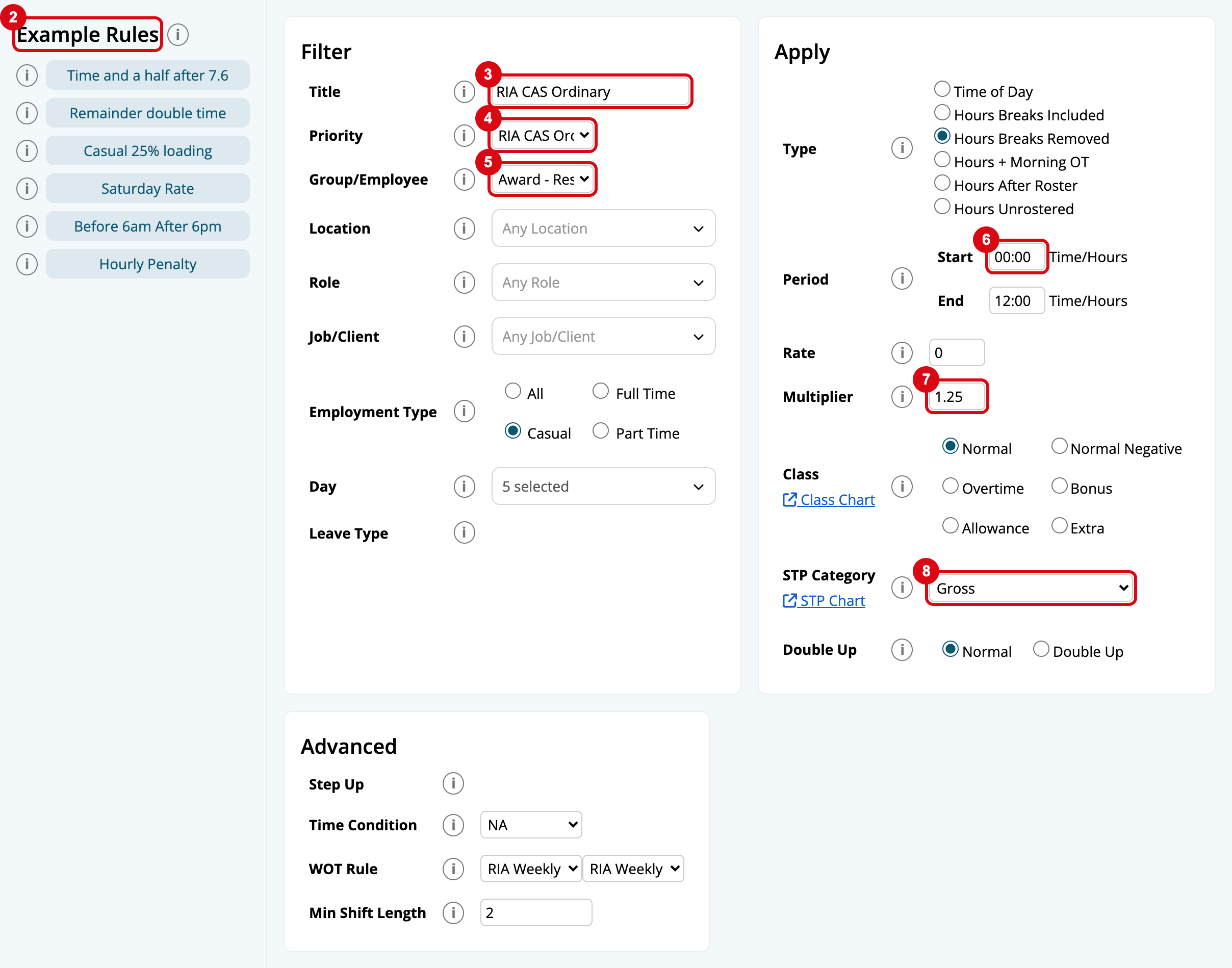
- Click one of the Example Rules on the left if it's close to what you need, such as Casual 25% loading or Time and a half after 7.6. It fills in the form for you to change.
- Enter a Title, up to 20 characters. It's shown on the payslip.
- Under Priority, choose where it goes in the list: Bottom, or before another rule.
- Choose who it applies to: Group/Employee, Employment Type and Day. If you use them, you can also choose the Location, Role and Job/Client.
- Choose the Type and enter the Period it covers. See the next section.
- Enter the Multiplier, such as "1.25" for a 25% loading, and leave Rate at 0 to use the employee's base rate. Enter a Rate only to pay a fixed hourly amount.
- Choose the Class and STP Category. See How Pay Is Calculated.
- Click Add Shift Rule. The button shows once every required field is filled in.
Tip
Before you pay anyone, check a new rule on your next pay run's payslips: each line shows the rule that paid it. If a line is wrong, fix the rule, then click Bulk Actions > Reprocess to recalculate the pay run. See Run a Pay Run.
Choose a Shift Rule's Type: time of day or hours worked
The Type decides what the Period means: clock times, or hours into the shift.
| Type | The Period is | Example |
|---|---|---|
| Time of Day | Clock times | 22:00 to 24:00 for late night work. 00:00 to 24:00 for the whole day |
| Hours Breaks Removed | Hours worked, after unpaid breaks | 07:36 to 24:00 for overtime after 7.6 hours worked |
| Hours Breaks Included | Hours since clocking on, breaks and all | 08:00 to 24:00 for overtime 8 hours after starting |
| Hours + Morning OT | Hours worked, pushed later by any overtime paid in the morning | An early start paid as overtime doesn't count towards the day's ordinary hours |
| Hours After Roster | Hours after the rostered shift ends | 00:00 to 02:00 pays the first 2 hours after the roster as overtime |
| Hours Unrostered | Hours on a day with no roster | 00:00 to 24:00 pays an unrostered day as overtime |
For a Time of Day rule, a Period that ends before it starts, such as 22:00 to 06:00, runs past midnight. The Day is checked for each part of a shift, so the hours after midnight count as the next day.
Pay a penalty on top of the hours with Double Up
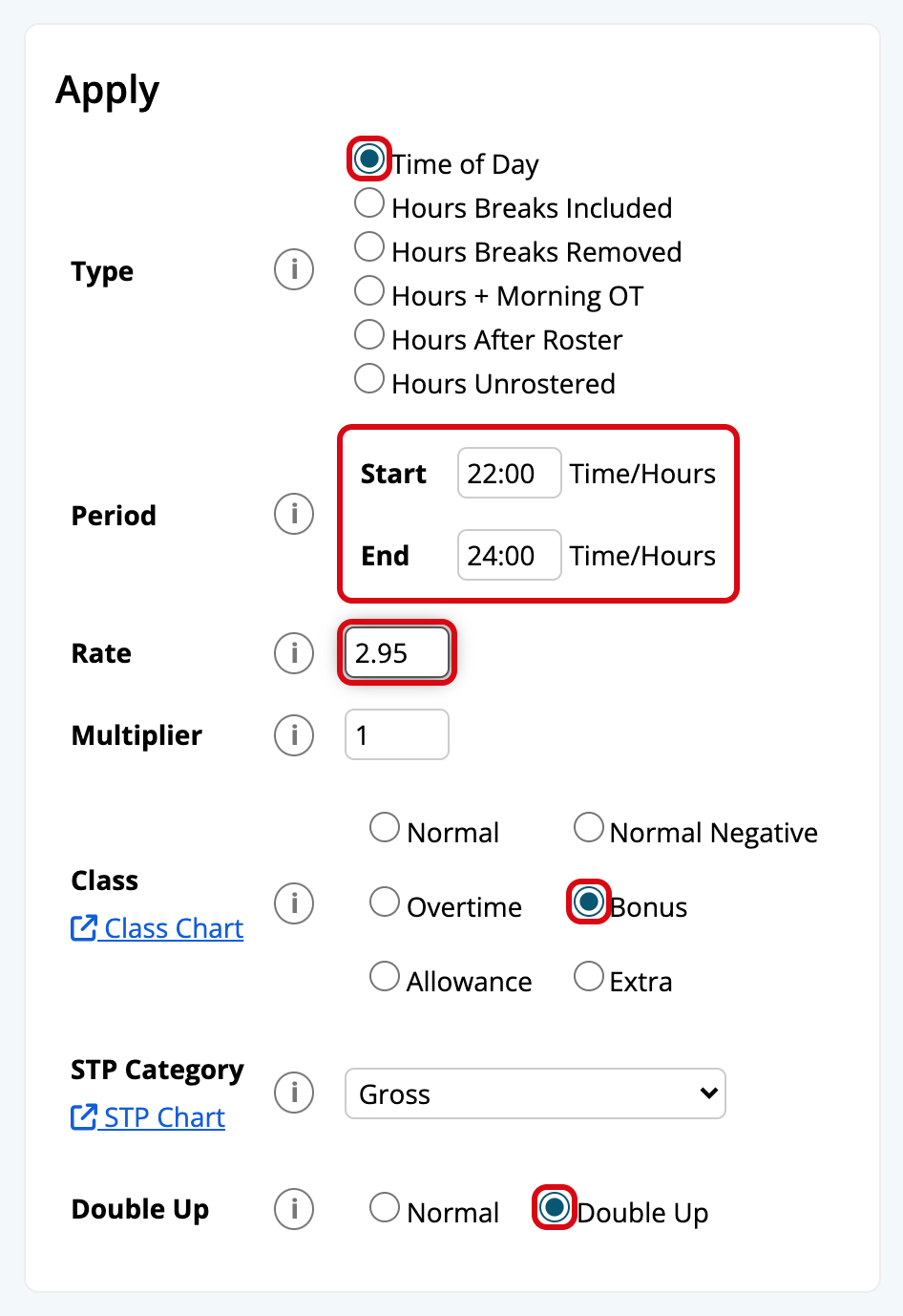
A rule set to Normal takes its hours from the rules below it. A rule set to Double Up pays on top, so the hours are still paid by another rule as well. Use Double Up for an amount added to every hour in a window, such as a late night penalty.
For example, for $2.95 an hour from 10pm to midnight on weekdays, add a Normal Rule with Type Time of Day, Period 22:00 to 24:00, Day Monday to Friday, Rate "2.95", Multiplier "1", Class Bonus and Double Up.
Pay a loading when a shift starts or ends at certain times
Under Time Condition, choose when the whole shift qualifies, and enter the times:
- Start: the shift starts between the times.
- End: the shift ends between the times.
- Both: it starts and ends between them.
- Either: it starts or ends between them.
For example, for a 15% loading on shifts that start in the afternoon, choose Start, 14:00 to 17:00, and a Multiplier of "1.15".
Pay a minimum shift length
Enter the minimum hours in Min Shift Length. A shorter shift is paid up to that many hours. For example, with "3", a 2 hour shift is paid as 3 hours. Casual minimum engagement is often 2 or 3 hours.
Pay higher duties
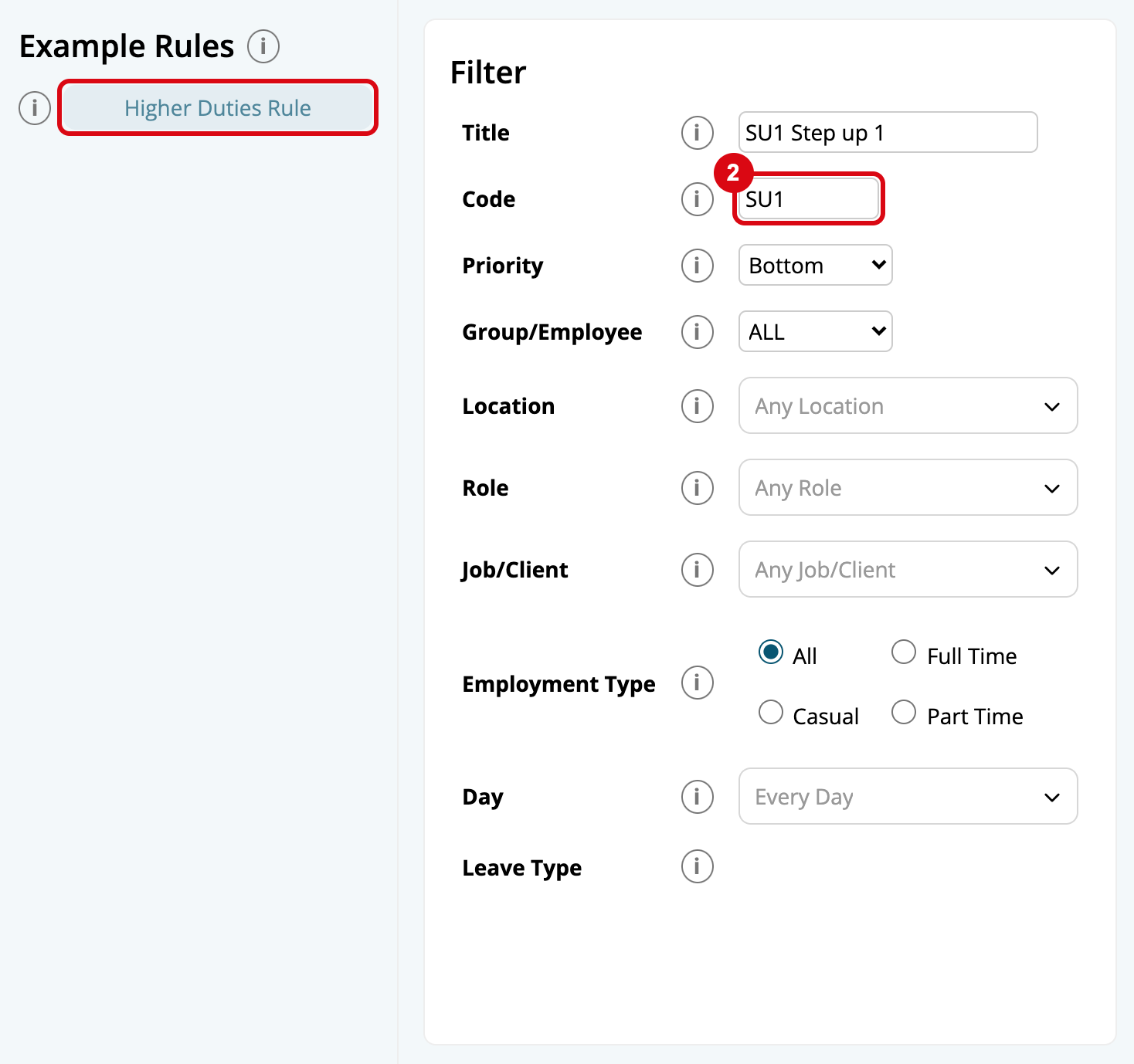
Higher Duties rules pay a shift worked in a higher role, such as a waiter filling in as supervisor. They're checked before Normal Rules, and Normal Rules pay any hours they don't.
- On the Higher Duties tab, click Add Higher Duty.
- Enter a Code with no spaces, such as "SU1", and fill in the rule as usual.
- To pay the role's overtime as well, add more Higher Duties rules with the same Code, such as one for ordinary hours at "1.15" and one for overtime at "1.725". Every rule with the Code is used together.
To pay a shift at higher duties, a manager chooses the rule under Higher Duties on the shift in Timesheets. Typing the Code into the shift's note also works.
Pay more when there's too little rest between shifts
Rest Rules pay a shift that starts too soon after the employee's last shift ended.
- On the Rest Rules tab, click Add Rest Rule, or click the Short Rest OT example.
- Under Step Up, enter the rest that triggers it: Between 4 and 10 hours, for example. The lower number stops a split shift's gap counting as rest.
- Enter the Multiplier, such as "2", and the rest of the rule.
When a Rest Rule applies, it pays the shift instead of the Worked PH, Leave and Normal Rules. The last shift of the previous pay period counts, so a short rest across two pay runs is still paid.
Pay a loading on leave
Leave is paid at the base rate unless a Leave Rule matches. Use a Leave Rule when leave needs its own rate, such as part time staff with a loading for irregular hours: on the Leave Rules tab, click Add Leave Rule or the 30% Leave Loading example, choose the Leave Type, and enter the Multiplier.
Annual leave loading doesn't need a Leave Rule. Enter it as a percentage, such as "17.5", in Annual Leave Loading on the employee's profile, under Entitlements.
Change the order Shift Rules apply
- Drag a rule by its handle in the Priority column.
- Or tick one or more rules and click Move to Top, Move to Bottom, or choose a rule under Move After....
- Or change Priority when you edit the rule.
To stop a rule being used without deleting it, tick it and click Draft. Click Activate to use it again. Only Active rules are used in pay runs.
Import or export Shift Rules
Click CSV Transfer, then Export CSV to download your rules, or Import CSV to add rules from a file. The file's tab column says which tab each rule goes on: Normal, Worked PH, Unworked PH, Leave, Higher Duties or Rest.